New Coalition Position Paper Calls for a Human Rights-Based Understanding of Transnational Repression in Germany

Berlin, 25 September 2026
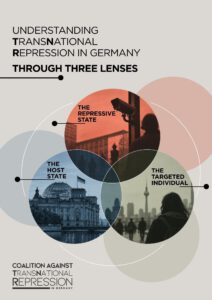
The Coalition Against Transnational Repression in Germany today publishes a new Position Paper titled “Understanding Transnational Repression (TNR) in Germany Through Three Lenses: The Repressive State, the Host State, and the Targeted Individual.”
The paper seeks to contribute to the growing discussion on how transnational repression is understood and addressed in Germany by placing the experiences, rights, and protection needs of targeted individuals at the centre of the analysis.
As awareness of transnational repression continues to grow across Europe, discussions have largely focused on questions of foreign interference, national security, and state sovereignty. While these approaches capture important dimensions of the phenomenon, the Coalition argues that they do not always fully reflect the lived realities of those directly affected.
The new Position Paper therefore proposes a complementary, human rights-based perspective that examines transnational repression through three interconnected lenses: the repressive state, which exports repression beyond its borders; the host state, which bears responsibility for providing protection; and the targeted individual, whose rights, safety, and wellbeing are directly affected.
A distinctive contribution of the Position Paper is its effort to provide greater conceptual clarity around transnational repression. The paper introduces a human rights-centred terminology for understanding those affected by TNR and examines how language shapes recognition, protection, and policy responses.
It outlines key concepts, including targeted individuals, affected individuals, victims, and survivors, while also clarifying the roles of perpetrators, proxies, and enablers in sustaining cross-border repression. The Coalition argues that clearer and more consistent terminology is essential for improving institutional recognition, documentation, and protection efforts.
The paper argues that authoritarian governments increasingly rely on forms of coercion that often fall below traditional criminal thresholds, including digital harassment, surveillance, threats against family members, reputational attacks, restrictions on documentation, and other forms of cross-border pressure.
While these practices may not always trigger criminal investigations, they can nevertheless have profound consequences for fundamental rights, mental wellbeing, civic participation, and social integration. By drawing attention to these cumulative harms, the paper highlights existing protection gaps and calls for responses that move beyond reactive enforcement towards preventive, rights-based protection.
„People who sought safety in Germany should not continue living under the shadow of the governments they fled. The way transnational repression is understood shapes the way institutions respond to it. If targeted individuals remain invisible in policy discussions, protection efforts will always fall short. This Position Paper seeks to place their rights, experiences, and protection needs at the centre of the conversation. Effective responses must begin by recognising targeted individuals as rights holders and placing their protection needs at the centre.“
— Basma Mostafa, Co-Spokesperson of the Coalition Against Transnational Repression in Germany
The publication builds on the Coalition’s broader policy and advocacy work. On 21 September 2026, the Coalition released an updated version of its Policy Paper, originally published in April 2025, which sets out recommendations for German institutions under four pillars: Monitor, Respond, Support, and Prevent.
While the Policy Paper focuses on practical and institutional responses, the newly published Position Paper provides the conceptual and human rights-based framework that underpins those recommendations. Together, the two publications aim to support policymakers, public institutions, civil society organisations, and affected communities in developing more effective, coordinated, and people-centred responses to transnational repression in Germany.
The Coalition Against Transnational Repression in Germany was founded in August 2024 and currently brings together 23 German human rights and diaspora organisations working to raise awareness of transnational repression and its impact on human rights, freedom, and security in Germany.
The Coalition is committed to advancing a better understanding of the phenomenon, strengthening protection and support for those affected, and raising awareness among policymakers, public institutions, government authorities, and the wider public.
To achieve these goals, the Coalition provides a platform for targeted individuals and civil society organisations to exchange knowledge and experiences, conducts public outreach and networking activities, and engages in joint advocacy efforts.
Read the Position Paper :