Coalition Against TNR in Germany Welcomes New Report on Freedom of Religion or Belief and Calls for Concrete Political Action
Berlin, 18 November 2026
The Coalition Against Transnational Repression in Germany welcomes the publication of the latest report by Thomas Rachel, the German Federal Government Commissioner for Freedom of Religion or Belief, covering the period from 2023 to 2025. For the first time, the report dedicates an entire chapter to transnational repression (TNR), highlighting a critical connection that has received insufficient attention in political discussions: the threat posed by authoritarian governments to freedom of religion or belief beyond their own borders.
TNR has been a reality in Germany for decades. Authoritarian governments seek to intimidate, surveil and silence individuals beyond their national borders. Religious and belief communities are among those affected, with individuals targeted because of their identities, beliefs or activism. Several organisations within our coalition represent communities that have experienced such forms of repression for generations.
The Coalition particularly welcomes the report’s nuanced analysis of the relationship between TNR and freedom of religion or belief. As the report highlights, individuals are often targeted not solely because of their religious or philosophical beliefs, but because their identities, convictions or activities abroad are perceived as a political threat by their countries of origin. Religious, cultural and political identities are often deeply interconnected. Recognising these dynamics is essential to understanding the motivations and mechanisms behind transnational repression and developing effective responses.
The Coalition further welcomes the report’s recognition that TNR often extends far beyond individual incidents. Its effects are cumulative and frequently impact entire diaspora and exile communities, creating fear, self-censorship, and reduced participation in civic, religious, cultural, and political life. These broader chilling effects are among the most harmful consequences of TNR and remain insufficiently recognised in public policy discussions.
“Transnational repression has affected our Buddhist community for generations. It extends far beyond political activism, reaching into our cultural identity, social life and religious practices. When authoritarian governments criminalise religious beliefs and continue to intimidate people even in exile, Germany can become a place of insecurity for those seeking safety. Freedom of religion or belief must not end at national borders. No one should have to fear persecution or reprisals for freely practising their religion or expressing their beliefs,” says Dundup Donka, Verein der Tibeter in Deutschland
The Coalition also welcomes the report’s acknowledgement of the significant gaps in available data on the relationship between TNR and freedom of religion or belief. Systematic, independent and victim-centred documentation is essential to understanding the true scale of the threat. Such efforts must also capture forms of intimidation and coercion that fall below the threshold of criminal prosecution but can nevertheless have profound consequences for those affected.
While the report highlights the practices of Iran, Russia and China, transnational repression is a global phenomenon employed by numerous other authoritarian governments against a wide range of exile and diaspora communities.
The Coalition recognises and appreciates the German Federal Government’s growing efforts to address TNR and give the issue greater political attention. However, existing measures remain insufficient. Acknowledging the problem is an important first step, but recognition alone does not amount to effective prevention or accountability. Those affected need accessible, multilingual and trustworthy support structures.
“We recognise and welcome the German government’s increasing attention to transnational repression. But political recognition alone does not protect people. Diplomatic discussions behind closed doors may serve an important purpose, yet their impact is often neither visible nor tangible to those affected. Governments responsible for threatening and intimidating people in Germany must not be able to rely on their actions being addressed solely through confidential diplomatic channels. We need stronger public condemnation, effective prevention and concrete protection measures. Transnational repression must carry political consequences for those responsible,” says Bärbel Heide Uhl, Spokesperson of the Coalition Against Transnational Repression in Germany.
The new report on freedom of religion or belief sends an important signal and represents a welcome step towards greater recognition of TNR as a serious human rights challenge in Germany. The priority now must be to translate this political recognition into concrete action that protects those targeted, prevents further repression, ensures effective support and reporting mechanisms, and holds both perpetrators and responsible governments accountable.
Further Reading:
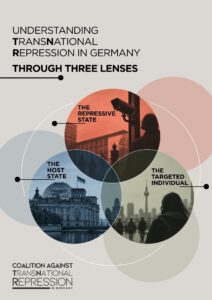
Understanding Transnational Repression (TNR) in Germany Through Three Lenses: The Repressive State, the Host State, and the Targeted Individual: position-paper-understanding-transnational-repression-tnr-in-germany-through-three-lenses-the-repressive-state-the-host-state-and-the-targeted-individual
Tackling Transnational Repression in Germany: https://stop-transnational-repression.de/2025/04/14/policy-paper-tackling-transnational-repression-in-germany/