The Quiet Face of Transnational Repression
An article by a member organization of the Coalition Against TNR in Germany
Most people picture transnational repression (TNR) as something out of the Cold War: poisonings, assassinations, spies. The murder of the Russian dissident artist Semyon Skrepetsky — shot in the Polish town of Biała Podlaska on 15 June 2026, days after he protested outside the Russian embassy in Berlin — fits that picture. Mikhail Klimarev, an exiled Russian IT specialist, doesn’t think that’s the whole picture though. He points out that the more “extreme” operations tend to fail: after the failed attempt to assassinate the Skripals in the UK in 2008 the agents were identified, their passports published and they ended up on Russian television trying to explain themselves. “It is not that easy,” he says.
Transnational repression is often quieter and less sensational, from governmental designations, to frozen bank accounts, leaked emails and pressure on family members. One of its aims is often to make everyone around that person — relatives, colleagues, co-authors, fellow members — quietly conclude that staying involved is not worth the risk. Over the past few years this administrative, largely digital and cumulative pressure has become what many of us in civil society actually mean by TNR. And because most countries have no legal definition for it, it is difficult to investigate, let alone prosecute, as an offence in its own right.
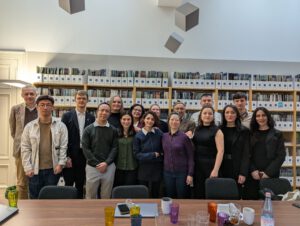
To look a bit deeper into the topic, we sat down with two targets here in Germany: Mikhail Klimarev, an IT specialist who was forced into exile, and Gabriele Freitag, Managing Director of the German Association for East European Studies (DGO), a research body focused on the region. One is a person and one an institution. One is in exile, one is not. Both show the quieter side of transnational repression which can affect all sorts of people.
The individual in exile: Mikhail Klimarev
Mikhail Klimarev is an IT entrepreneur who heads the Internet Protection Society and worked on the technical infrastructure behind Alexei Navalny’s Smart Voting project. In August 2021, police came to his door with what he describes as a torn-out notebook page reading „search warrant.“ He told them what he thought of it. They said they would come back the next day.
He did not wait. „I took the cat to my sister, packed a bag, and left.“ On 13 September 2021 — only months before the full-scale invasion — he crossed out of Russia on foot, wheeling a bag across the Queen Louise Bridge over the Neman River into Lithuania.
The repression did not stop at the border. After he left, the cases began. He was designated a „foreign agent“ in May 2022, then charged in a string of disparate criminal cases. One is for extremism: in the first weeks of the war he posted footage of riot police beating teenagers in Yekaterinburg next to footage of the same forces advancing on Kyiv, and wrote that such men should be taken prisoner. Others concern “foreign agent” violations and what he describes as treason, tied to his advocacy for sanctions on the companies that supply Russia’s internet-blocking equipment.
The machinery has kept grinding since. His Russian phone number was switched off — operators, he notes, can disconnect any subscriber at the authorities‘ request — and with it went the two-factor authentication he needed to log in to state services. A long series of fines followed, and the money was simply taken off his Russian accounts. As a “foreign agent” he is funneled into a single mandated account, which makes sending money home a quasi-legal impossibility: his designation as a „terrorist“ means any relative who receives it can be accused, quite literally, of aiding and abetting terrorism. He cannot meaningfully fight any of it from outside. Retrieving the case files would mean sending a lawyer in person to Yekaterinburg, and he knows that lawyer personally. He has watched what happened to Navalny’s lawyers. „I will sign for this and he will then be jailed,“ he says.
His mother is elderly. „I will not go to my mother’s funeral; I will not be able to come.“
The attacks that do reach him are digital, and constant. Hacking attempts, threats by messenger, email and social media — for him and for dozens of colleagues and partners, this is routine background noise. He is convinced it is organised: that Russia hosts specialised outfits, probably dozens of them, doing the cyber-persecution of exiles as professional work. He has stopped using phone numbers altogether. He makes no calls and sends no SMS, gives his numbers to no one, and changes them regularly, on the assumption that they are readable by the security services. He calls this his professional paranoia.
Geography has narrowed too. It is not the fear of a forced landing that keeps him out of Turkey but the fact that Turkey extradites wanted persons — as, he assumes, would Thailand, Vietnam, Indonesia and most of the world. What is left is the EU, the US, Canada and the UK. He once talked himself out of a conference in Taiwan because the flight path crossed China. At European passport control, he says, „that little light comes on“ and he is taken aside to wait with no information. Nothing has happened, and the probability of disaster is low — but, as he puts it, „that one percent remains.“
The institution: German Association for East European Studies (DGO)
The German Association for East European Studies (DGO) is a German membership body of more than a thousand scholars and institutions that has analysed Russian politics critically for years.
In early 2024 the DGO was branded an „undesirable organisation.“ That alone was serious but not unique; other European NGOs had been listed before. The escalation came in July 2024, when it was additionally designated „extremist“ — to its knowledge, the first and so far only German organisation to carry that label. No official explanation was ever given. Attempts to obtain one, including through legal channels and the German Foreign Office, went nowhere.
Alongside it came cyberattacks on the organisation’s email servers, with communications accessed and leaked, attributed to Russian-linked groups, forcing costly investment in security on a digital level.
Just like Mikhail, there was no room for legal recourse with regards to the extremist listing. When the DGO challenged the designation in Russian courts, it was told it had no standing to do so: it was not individually listed but supposedly part of a „Russian separatist movement“ alongside a number of other European and Russian organisations – a movement which of course doesn’t exist. With no domestic avenue left, the organisation is now weighing a case before the Human Rights Committee of the United Nations.
Here too, the damage is mostly indirect. Membership lists are not public, yet members worry that association could create risks. Some avoid travel to certain countries; scholars with Russian ties are especially cautious. At one international congress, participants asked to use pseudonyms once the designation became public. Universities have asked whether merely displaying the DGO’s logo could endanger their staff. “The uncertainty itself is already a form of pressure,” says Gabriele Freitag, their leader. “And it’s scary.”
What shall we do?
Neither cases included direct violence. Both were reached with paperwork and for both, the legal exit was shut from the start. Mikhail can’t get hold of his own case file without putting his lawyer at risk; the DGO was told it had no standing to challenge its listing as extremist organisation at all. Both were hit online too — his number cut off and his logins frozen, the DGO’s servers hacked and its emails leaked.
It’s clear that often the real damage of TNR is indirect. The aim isn’t to jail Mikhail or shut down the DGO so much as to make the people around them think twice about staying involved.
Asked whether they’d backed off, both said no. The DGO put it plainly: “We have not changed our policies and we will continue our work as before.” Mikhail still continues with his work.
Because TNR knows no borders — individual and organisational, exile and international — the response has to be plural as well. The DGO’s own demands map onto exactly that. Here’s what they said we need:
●Systematic documentation and monitoring, so that governments see a pattern rather than a scatter of isolated cases.
●Legal and financial support for those targeted, including the cost of cybersecurity.
●Genuine international coordination to coordinate responses across the EU and the UK, plus other countries.