LDSF Position Paper Examines the Use of Counterterrorism as a Tool of Transnational Repression
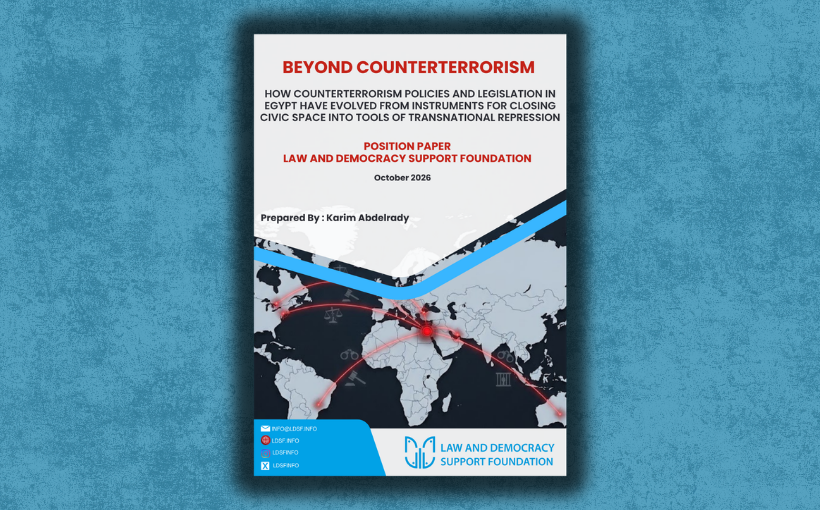
Law and Democracy Support Foundation (LDSF), a founding member of the Coalition Against Transnational Repression in Germany, has published a new position paper entitled “Beyond Counterterrorism: The Use of Counterterrorism Laws and Policies to Restrict Civic Space and Facilitate Transnational Repression.” The paper examines how Egyptian authorities have expanded the use of counterterrorism legislation and security policies beyond their stated purpose, transforming them into tools for restricting civic space, suppressing dissent, and facilitating patterns of transnational repression targeting Egyptians both inside the country and abroad.
The publication analyzes three key pieces of legislation: the Counterterrorism Law, the Terrorist Entities and Terrorists Lists Law, and the Anti-Cyber and Information Technology Crimes Law. It argues that broad definitions, expansive executive powers, and weak procedural safeguards have enabled the use of these laws against journalists, human rights defenders, academics, political opponents, and other individuals engaged in peaceful expression and public affairs.
Drawing on documented cases and legal analysis, the paper identifies eight patterns of transnational repression linked to the implementation of counterterrorism policies and legislation. These include the criminalization of cooperation with individuals and organizations abroad, punishment by proxy through targeting family members, smear campaigns, digital censorship and blocking measures, trials in absentia, misuse of regional security cooperation mechanisms and INTERPOL procedures, designation on terrorism lists, and enforced disappearance in a transnational context.
The paper argues that transnational repression should not be understood as an exceptional practice but rather as an extension of a broader governance model that prioritizes security-based approaches over political pluralism, public participation, and respect for fundamental rights. It concludes that meaningful reform requires restoring the separation of powers, strengthening judicial independence, and bringing counterterrorism measures into compliance with international human rights standards.
The publication also presents recommendations addressed to Egypt’s legislative, judicial, and executive authorities, as well as to international actors, including host states, the United Nations, INTERPOL, donors, and regional organizations. These recommendations call for legislative reform, stronger safeguards against transnational repression, accountability for enforced disappearance and torture, protection for individuals targeted abroad, and increased scrutiny of international security cooperation mechanisms.
Read and download the full paper here: